
Local know-how
Formosan Termites in the Lowcountry
They arrived in Charleston in the 1950s and work their way down the coast. How to tell them from the native kind, when they swarm, and what to do without panicking.
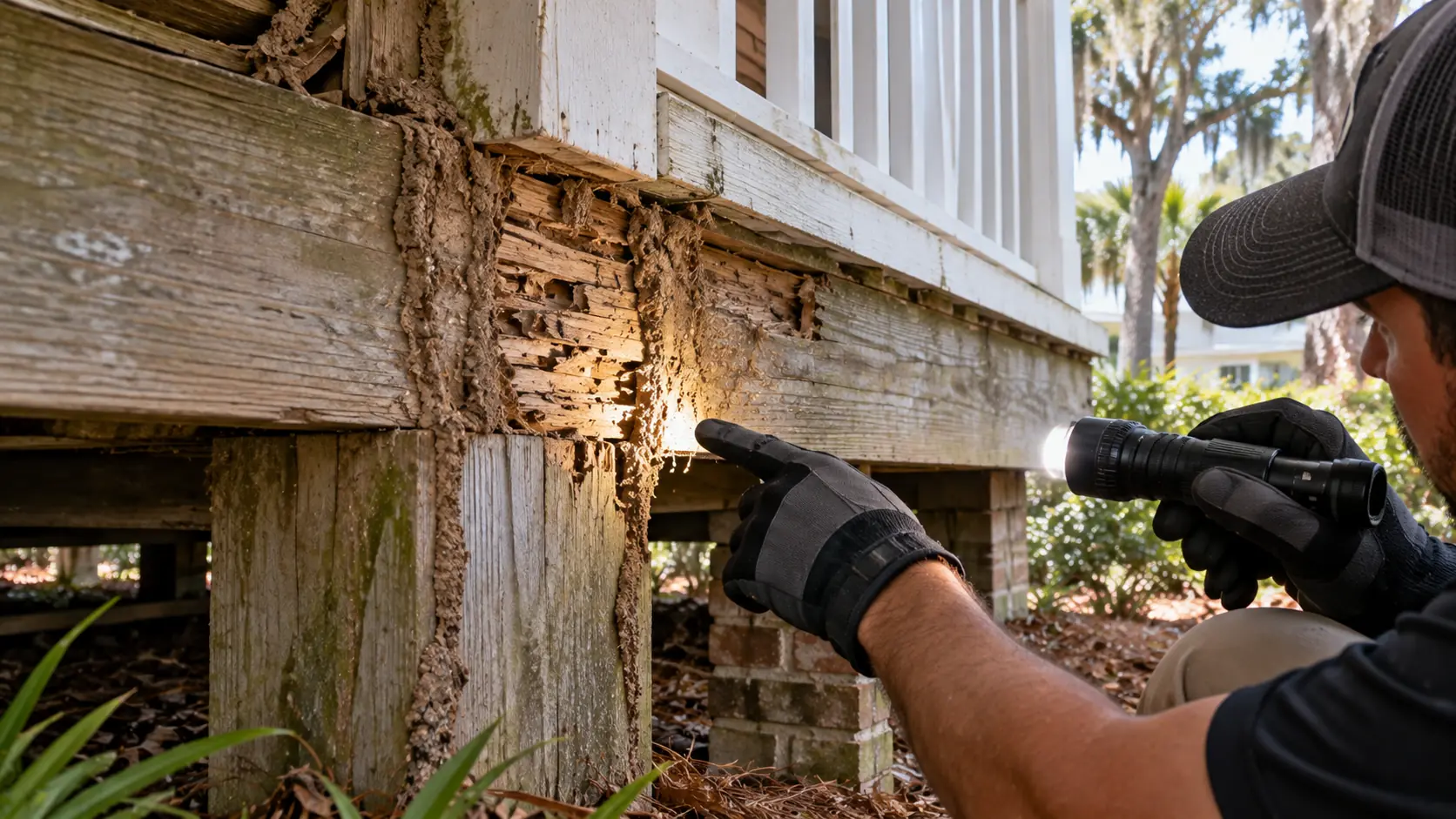
Some immigrants arrive with a trunk and a letter of introduction. The Formosan subterranean termite arrived without either. Clemson says it was introduced in Charleston in the mid-1950s. (Clemson HGIC) It has been working its way through the coast ever since.
When I bought my house in Port Royal, I learned two words I’d never had reason to care about: “bond” and “Formosan.” Here’s what I wish someone had told me about the second one.
Where They Are
As of Clemson’s 2022 update, Formosan termites had been found in 16 South Carolina counties, including Beaufort and Jasper. They’re “most concentrated in coastal areas, from Charleston south to Beaufort.” Clemson’s 2000 fact sheet named Hilton Head Island and the area near the city of Beaufort specifically. (Clemson HGIC, Clemson HGIC 2424)
Clemson adds a sensible caution: finding them in a county “does not mean they are found uniformly throughout a county.”
How They Differ
The native eastern subterranean termite is no gentleman, but the Formosan works on a bigger scale. Clemson says a Formosan colony “may have a million or more” termites, against roughly 100,000 workers in a native colony. Formosans are also “more apt to make aerial nests,” colonies off the ground that Clemson says can be harder to detect and treat. (Clemson HGIC)
Then Clemson says something worth hearing: “Some individuals have referred to Formosan termites as super termites. They are not.” (Clemson HGIC) The same treatment products and strategies used on native termites work on Formosans. (Clemson HGIC FAQ)
When They Swarm
This is the easy way to tell them apart. Native termites usually swarm in early spring, often in the afternoon. Formosans “often have swarms from mid-May to July, often in the evening, with the swarmers attracted to lights.” (Clemson HGIC) Formosan swarmers are about half an inch long and golden brown. Native swarmers are smaller and dark. (Clemson HGIC FAQ)
So the sign is a warm evening in late May, a porch light, and a cloud of golden-brown wings. The morning after, look for dead swarmers and shed wings on windowsills and in spider webs, which University of Georgia Extension lists among the telltale signs. (UGA Extension)
What to Do
Clemson’s first instruction is the best one: “don’t panic.” Have the house inspected “from the foundation to the roof,” talk to “one, two, or even three companies,” and don’t feel pressured to sign for treatment on the spot. (Clemson HGIC)
If you’re not sure what you’ve found, collect a few in a jar of rubbing alcohol and call your county Extension office, or Clemson’s Home and Garden Information Center at 1-888-656-9988. (Clemson HGIC 2424)
Then read your termite bond. A South Carolina regulation requires it to say whether Formosans are covered. (SC Code Regs. 27-1085) Ray Croft walks through the rest in termite bonds in South Carolina.
Taking Away the Welcome Mat
The prevention list Clemson gives, as reported by the Post and Courier, reads like a list of things every old house down here does wrong: remove wood debris from the crawl space, ventilate it, end wood-to-ground contact, go easy on the mulch, and keep the gutters clean and the water running away from the house. (Post and Courier, May 2026)
None of it is glamorous. Neither is a sagging floor joist. The termites have had seventy years to settle in along this coast. The least we can do is stop leaving the door open.