
Cost guides
Crawl Space Encapsulation: What It Costs and What You're Paying For
Why vented crawl spaces stay wet in this climate, what a closed crawl space involves, and the price ranges that actually hold up.
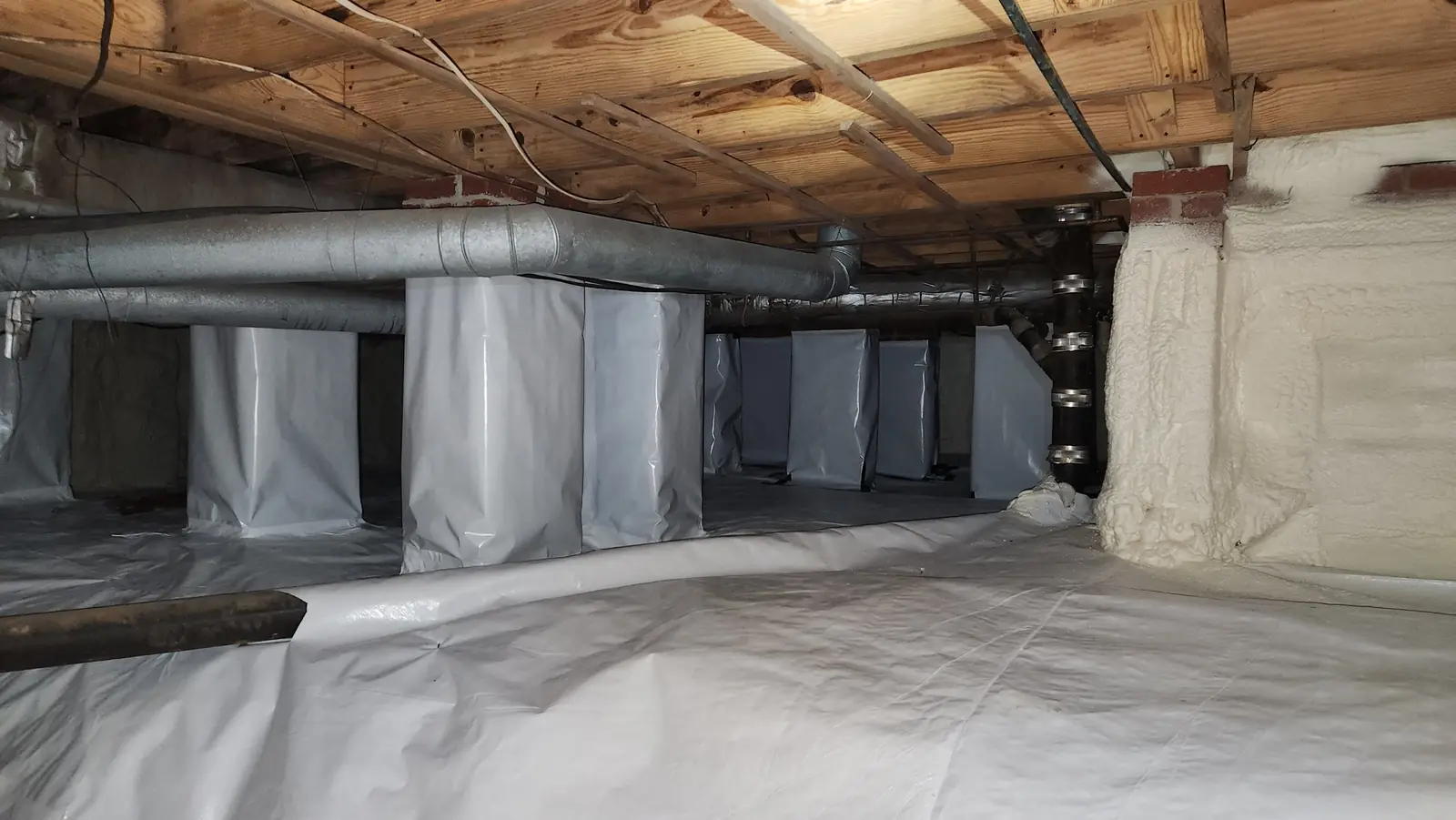
For a long time the rule was simple: crawl spaces get vents, vents let the moisture out. In a place like this, it works the other way. On a July afternoon in Bluffton the air outside holds more water than the cool air under your house, so the vents let it in, and it condenses on the coldest thing it finds. That’s your ductwork, your floor framing and your insulation.
That isn’t my opinion. It’s what the research found.
What the Research Says
The Department of Energy put it plainly: in humid climates, “the air from outside is often more moist than the air in the crawlspace.” Its Building America work on sealed crawl spaces found heating and cooling savings of 15 to 18 percent and humidity reductions of more than 20 percent, and that research helped change the national residential code. (DOE Building America)
The study I’d show a skeptic comes from Advanced Energy in North Carolina, which watched 12 houses in the Southeast for most of a year. The wall-vented crawl spaces sat above 70 percent relative humidity 98 percent of the time. The closed ones were above 70 percent only 5 percent of the time, and the conditions for condensation never showed up in them at all. (Advanced Energy, ACEEE proceedings)
For reference, the EPA recommends keeping indoor humidity below 60 percent. (EPA)
What You’re Paying For
Encapsulation is a few jobs done together:
- A sealed liner on the ground and up the walls. Building Science Corporation’s spec is 6-mil polyethylene with taped joints, attached at the walls. South Carolina’s version of the residential code calls for a Class A vapor retarder with sealed six-inch overlaps that runs at least six inches up the wall. (Building Science, SC Code Regs. 8-1221)
- Closing the vents.
- A way to dry the air. This is the part that gets skipped. The state code gives a few options: a small supply of conditioned air from the house system, continuous exhaust, or a dehumidifier sized to the manufacturer’s specs. As Building Science puts it, “Crawl spaces must always have a drying mechanism.”
- Insulation, usually moved from under the floor to the walls.
- Whatever was already wrong: standing water, mold, rotten wood, termite damage.
What It Costs
I couldn’t find South Carolina or Southeast numbers, so these are national, from cost guides updated this year:
- This Old House: about $5,500 on average, with a range of $1,500 to $15,000, and $3,000 to $7,000 for a 1,000-square-foot crawl space. A dehumidifier with wiring runs $800 to $2,000, mold remediation $500 to $4,000, and drainage $600 to $1,800. (This Old House, March 2026)
- HomeAdvisor: an average of $5,500 and a typical range of $5,000 to $15,000, with labor making up 50 to 70 percent of the bill and permits running $50 to $250. (HomeAdvisor, June 2026)
What moves the number, according to those guides: square footage, how thick and how well sealed the liner is, debris and structural repairs, existing water or mold, the insulation you choose and the dehumidifier.
Questions I’d Ask Before Signing
- How are you drying the air, and is the dehumidifier sized to this space?
- Where does the dehumidifier drain?
- What happens to the termite inspection access? Your pest company will want to see the walls.
- Is there water getting in from outside, and are you fixing that or just covering it?
- What’s the warranty on the liner and on the dehumidifier, and who services the unit?
A Dry Floor Is the Whole Point
A closed crawl space isn’t magic. It’s a liner, some sealing and a machine that keeps running. Done right, the Southeast data says it stays dry when a vented one won’t. Done halfway, it’s a nice-looking plastic floor over the same wet air.